Free quotes from local lawn and garden businesses, New Zealand wide
Lawn Aeration: What It Is, When to Do It and What It Costs
Lawn aeration means making holes in the lawn so air, water and fertiliser can get down to the roots. It helps most on lawns that are compacted by foot traffic, sit on heavy clay, or stay soggy after rain. In most of New Zealand the best times are autumn and spring, when the grass is growing and can fill the holes quickly.
Signs your lawn needs aerating
- Water pools on the surface or runs off instead of soaking in.
- The soil is hard enough that a screwdriver or garden fork is difficult to push in.
- Grass is thin along paths, around the clothesline and where people and dogs run.
- Moss is creeping in, which often means poor drainage and compaction.
- The lawn is on clay or was laid over compacted builders’ fill.
Core aeration or spiking
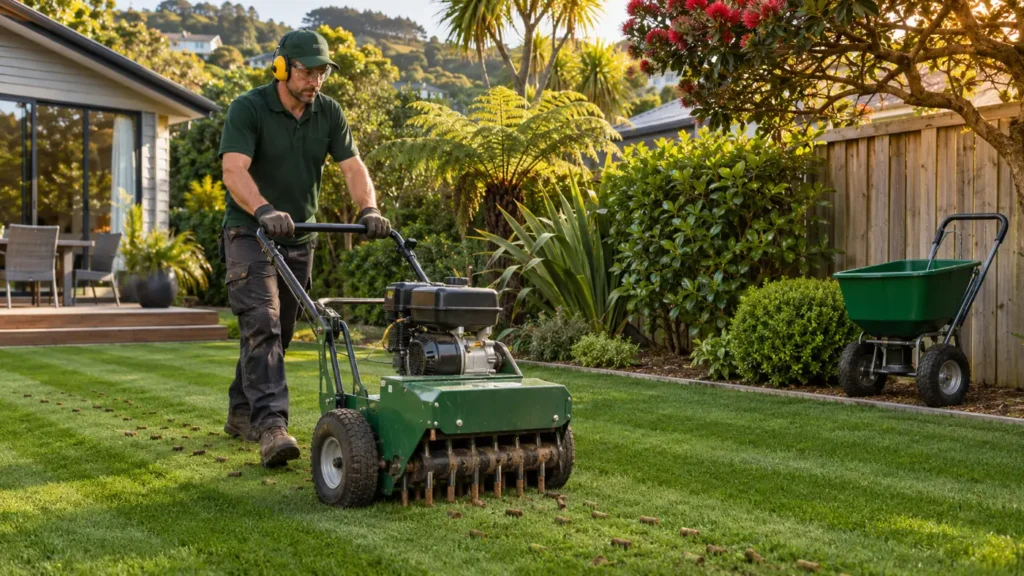
Core aeration (also called hollow tining) pulls out small plugs of soil and leaves them on the surface to break down. It relieves compaction properly and is what most lawn contractors use. Garden Box, a Christchurch garden supplier that hires out a petrol core aerator, says core aeration improves airflow, water and fertiliser uptake, reduces runoff and puddling, and helps the lawn cope with heat and drought.
Spiking pushes solid tines into the ground without removing soil. It is quicker and fine for light compaction, but on clay it can squeeze the soil around each hole tighter. Tui suggests spiking compacted patches with a garden fork to 5 to 10 cm deep, then top-dressing.
When to aerate in New Zealand
Most NZ lawns are cool-season grasses such as ryegrass, fescue and browntop. Yates says these grow most in autumn and spring and slow down in winter and the hottest part of summer, so those growing seasons are when the lawn recovers best. Warm-season lawns such as kikuyu grow from late spring to early autumn, so aerate them in late spring or early summer.
Aerate when the soil is moist but not saturated. Dry clay is too hard for the tines, and a waterlogged lawn smears and compacts further. The day after decent rain, or a good watering the day before, is ideal.
How to aerate your lawn
- Mow the lawn a little shorter than usual.
- Water the day before if the soil is dry.
- Go over the whole lawn once with the aerator or fork, then a second time across the first pass on badly compacted areas.
- Leave the cores on the surface. They break down in a week or two, faster if you run the mower over them.
- Follow up while the holes are open: overseed thin patches, spread a lawn fertiliser, or top-dress with sandy lawn mix.
- Water it in.
What lawn aeration costs
Contractors in New Zealand usually price aeration by the square metre with a minimum charge. As one published example, Lawn Rescue in the top of the South Island lists its core aeration and dethatching service at a $189.50 minimum for lawns under 175 m², then $1.10 per m² for 175 to 250 m², $1.00 per m² for 251 to 600 m², and $0.91 per m² over 600 m².
Doing it yourself is cheaper if you have the time. Garden centres and hire shops rent petrol core aerators by the half or full day, and manual corers and spiking tools cost far less. A small lawn can be done with a garden fork.
Prices vary by region, lawn size, slope and whether the job includes dethatching, fertilising or overseeding. To compare real prices for your lawn, describe it once on our Get quotes page and local lawn care businesses will send you their quotes.
Quick answers
| Question | Short answer |
|---|---|
| Best time in NZ | Autumn or spring for most lawns; late spring to early summer for kikuyu |
| How often | Once a year for most home lawns; high-traffic clay lawns may need autumn and spring |
| Best method | Core aeration (hollow tines) for real compaction; spiking for light jobs |
| Soil condition | Moist but not soggy |
| Typical contractor price | Per square metre with a minimum charge, often bundled with dethatching and feeding |
Aeration by region
| Region | What to expect |
|---|---|
| Northland and Auckland | Mild winters and warm-season grasses such as kikuyu are common. Aerate cool-season lawns in autumn; aerate kikuyu in late spring or early summer when it is growing hard. |
| Waikato and Bay of Plenty | Heavy and volcanic soils compact under foot traffic. Autumn after the first good rain is usually ideal. |
| Wellington and Hutt Valley | Clay and wind-dried soils. Avoid dry summer ground; aim for autumn or spring when the soil is moist. |
| Canterbury | Dry summers and stony or silty soils. Aerate in autumn or early spring, and water first if the ground is hard. |
| Otago and Southland | Short growing season and frosts. Spring and early autumn give the lawn time to recover before cold weather. |
DIY or hire a contractor?
| Do it yourself | Hire a lawn care business | |
|---|---|---|
| Cost | Tool hire or a fork; your time | Per m² with a minimum charge |
| Results | Fork or spiker fine for small patches; hired corer for whole lawns | Commercial core aerator, even depth and coverage |
| Extras | You buy seed, fertiliser and top-dressing | Often bundled with dethatching, feeding and overseeding |
| Best for | Small lawns, light compaction | Large, heavily compacted or clay lawns |
Mistakes to avoid
- Aerating bone-dry clay. The tines bounce off and you do little good.
- Aerating a waterlogged lawn. The holes smear shut and you compact the soil around them.
- Running over irrigation lines or shallow cables. Mark sprinkler heads and pipes first.
- Removing the cores straight away. Leave them; they break down and return soil to the surface.
- Aerating in the middle of a summer drought or a cold snap, when the grass cannot recover.
- Skipping the follow-up. Overseeding and feeding while the holes are open is where much of the benefit comes from.
Common questions
How often should I aerate?
Once a year is plenty for most home lawns, and only the compacted parts may need it. Heavy-use lawns on clay may benefit from autumn and spring.
Should I aerate or scarify first?
If the lawn has a thick thatch layer, scarify first, then aerate. See our guide to scarifying and dethatching.
Can I mow straight after aerating?
Yes. Mowing over the cores helps break them up.
What is the difference between aerating and scarifying?
Aerating makes holes in the soil to relieve compaction. Scarifying removes the layer of dead thatch on top of the soil. Many lawns benefit from both, scarifying first.
Does aerating help with moss?
It helps by improving drainage and letting air into wet, compacted soil, which are two of the conditions moss likes. You still need to kill and rake out existing moss.
Should I water after aerating?
Yes, especially if you have overseeded or fertilised. Water helps settle seed and carries fertiliser into the holes.
Can I aerate a new lawn?
Wait until it is well established, usually after its first full growing season.
How deep should aeration go?
Hired core aerators typically pull plugs a few centimetres long; the Ryan Lawnaire hired out by Garden Box cores up to 70 mm. A garden fork to 5 to 10 cm is enough for spot treatment.
Related services and guides
Find a local business: Lawn care and treatments, Lawn mowing, New lawns.
By city: Auckland, Hamilton, Tauranga, Wellington, Hutt Valley, Christchurch, Dunedin.
Read next: Scarifying and dethatching, Getting rid of moss, When to fertilise, How much lawn mowing costs in NZ.
Sources
- Garden Box, “Lawn / Turf Aerator / Coring (Hire)” and Ryan Lawnaire IV hire page, gardenbox.co.nz, read 21 November 2026.
- Lawn Rescue NZ, services and pricing, lawnrescue.co.nz, read 21 November 2026.
- Tui, “How to treat moss in lawns”, tuigarden.co.nz (spiking 5 to 10 cm deep), read 21 November 2026.
- Yates NZ, “Lawn watering tips” (cool-season and warm-season growing periods), yates.co.nz, read 21 November 2026.
Checked against the sources above on 21 November 2026. Prices and product directions change, so check the current label or quote before you buy.
